Introduction to AI and Its Real-World Applications
A comprehensive look at how artificial intelligence is transforming industries — from healthcare and finance to creative workflows and everyday automation.
The AI Revolution Is Already Here
Artificial intelligence is no longer a futuristic concept confined to research labs. It's embedded in the products we use daily — from voice assistants and recommendation engines to fraud detection systems and autonomous vehicles.
What Is AI, Really?
At its core, AI refers to systems that can perform tasks that typically require human intelligence. This includes learning from data, recognizing patterns, making decisions, and even generating creative content.
The field broadly breaks down into:
- Narrow AI (ANI): Systems designed for specific tasks — like spam filters, chatbots, or image classifiers. This is what most "AI" products are today.
- General AI (AGI): Hypothetical systems with human-level reasoning across any domain. We're not there yet.
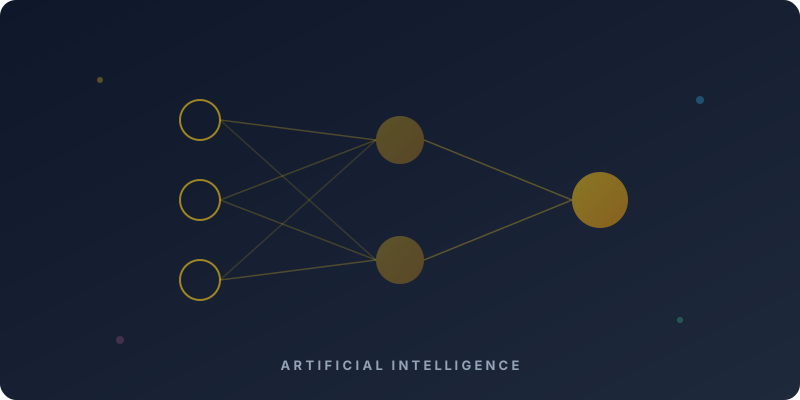
- Machine Learning (ML): A subset of AI where systems learn from data without being explicitly programmed. Deep learning, using neural networks, has driven most recent breakthroughs.
Real-World Applications
Healthcare
AI is accelerating drug discovery, enabling early disease detection through medical imaging, and powering personalized treatment plans. Models can now detect cancer in radiology scans with accuracy matching experienced clinicians.
Finance
From algorithmic trading to credit scoring and fraud detection, AI processes massive datasets in real-time to identify patterns humans would miss. Banks use NLP to analyze customer sentiment and automate compliance workflows.
Manufacturing
Predictive maintenance powered by IoT sensors and ML models reduces downtime by up to 50%. Computer vision systems perform quality inspection at speeds impossible for human workers.
Software Development
AI-powered code assistants like GitHub Copilot and Claude help developers write, debug, and refactor code faster. AI is also used for automated testing, code review, and DevOps optimization.
The Ethical Dimension
With great power comes great responsibility. AI systems can perpetuate biases present in training data, raise privacy concerns, and displace certain job categories. Responsible AI development requires:
- Transparent model training and decision-making
- Diverse and representative datasets
- Human oversight for critical decisions
- Clear accountability frameworks
What's Next?
The convergence of large language models, multimodal AI, and edge computing is creating new possibilities. We're moving toward AI systems that can reason, plan, and collaborate — not just pattern-match. The key is building these systems responsibly while making them accessible to everyone.
"The question is not whether AI will transform every industry — it's whether we'll be ready when it does."