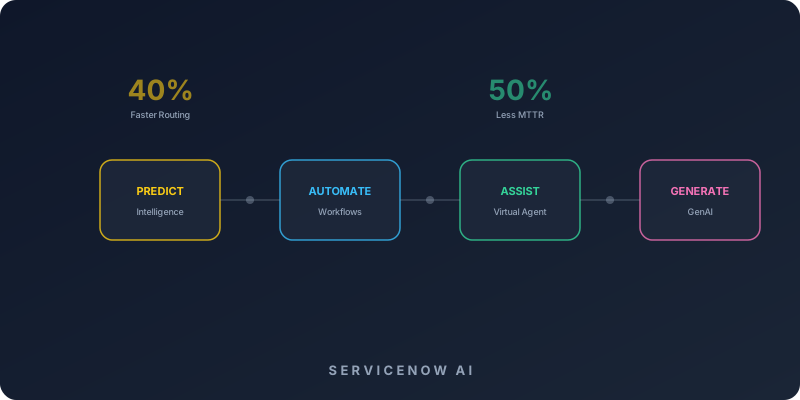
ServiceNow AI Capabilities and Use Cases
Exploring how ServiceNow leverages AI — from Predictive Intelligence and Virtual Agents to GenAI-powered workflows that transform enterprise service management.
ServiceNow Meets AI: A Game-Changer for Enterprise
ServiceNow has evolved far beyond a simple ticketing system. With deep AI integration across its platform, it's become an intelligent workflow engine that can predict, automate, and optimize enterprise operations at scale.
Predictive Intelligence
ServiceNow's Predictive Intelligence framework uses machine learning to:
- Auto-categorize incidents — Classify incoming tickets by category, priority, and assignment group with 90%+ accuracy
- Predict resolution times — Estimate how long issues will take based on historical patterns
- Identify similar incidents — Surface related past incidents to accelerate troubleshooting
- Detect anomalies — Flag unusual patterns in service desk metrics before they become critical
The beauty is that these models train on your organization's own data, improving continuously as more tickets flow through the system.
Virtual Agent & NLU
The Virtual Agent provides conversational AI experiences:
- Natural Language Understanding (NLU) models parse user intent from free-text input
- Pre-built conversation flows handle common requests (password resets, access requests, hardware orders)
- Contextual handoff to human agents when the bot reaches its limits
- Multi-channel support — web portal, Slack, Microsoft Teams, mobile
Building a Virtual Agent Topic
A well-designed topic follows this pattern:
- Greeting & intent detection — Understand what the user needs
- Entity extraction — Pull key details (ticket number, asset name, urgency)
- Action execution — Create records, query databases, trigger workflows
- Confirmation & follow-up — Verify completion and offer next steps
GenAI on ServiceNow
The Now Assist platform brings generative AI directly into ServiceNow:
- Case Summarization — Automatically generate summaries of complex incident histories
- Knowledge Article Generation — Create KB articles from resolved incidents
- Code Assist — Help developers write server-side scripts, business rules, and client scripts
- Search Enhancement — Natural language search across the knowledge base
AIOps: Intelligent Operations
ServiceNow AIOps correlates data across monitoring tools to:
- Reduce alert noise by grouping related alerts into actionable incidents
- Identify root causes across infrastructure layers
- Automate remediation through predefined playbooks
- Provide capacity planning insights based on usage trends
Real-World Impact
Organizations implementing ServiceNow AI typically see:
- 40-60% reduction in ticket routing time
- 30% improvement in first-contact resolution
- 50% decrease in mean time to resolution (MTTR)
- 25% reduction in service desk call volume through self-service
Getting Started
The key to successful ServiceNow AI adoption:
- Start with clean, well-structured data in your CMDB and incident tables
- Begin with high-volume, repetitive use cases (incident categorization is a great first win)
- Train models on at least 6 months of historical data
- Iterate — monitor model performance and retrain regularly
- Combine AI with solid process design; AI amplifies good processes
ServiceNow AI isn't about replacing service desk agents — it's about giving them superpowers.