What Are AI Agents and How They Work
Understanding autonomous AI agents — how they reason, plan, use tools, and take action to accomplish complex tasks without constant human supervision.
Beyond Chatbots: The Rise of AI Agents
If you've used ChatGPT or Claude, you've interacted with a large language model (LLM). But an AI agent is something more — it's an LLM given the ability to reason, plan, and take action in the real world.
The Agent Loop
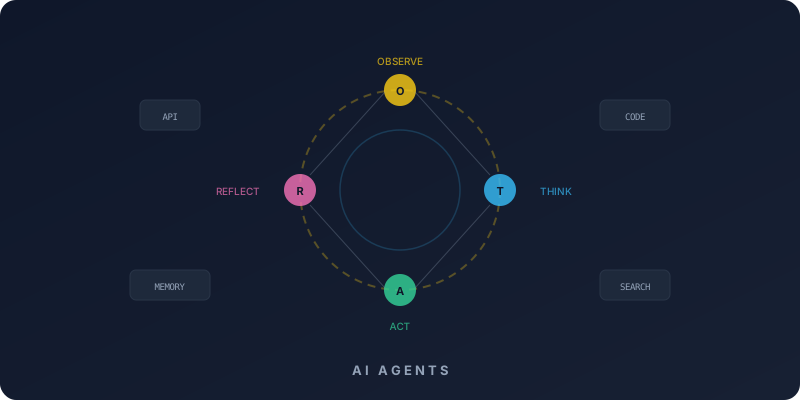
At its simplest, an AI agent follows a loop:
- Observe — Receive a task or input from the user or environment
- Think — Reason about what needs to be done, break the task into steps
- Act — Execute actions using available tools (APIs, code execution, web search)
- Reflect — Evaluate the result and decide on next steps
This loop repeats until the task is complete. The key difference from a chatbot is autonomy — agents can make multi-step decisions and recover from errors.
Key Components
The Brain: Large Language Model
The LLM provides reasoning, language understanding, and decision-making. Models like Claude, GPT-4, and Gemini serve as the cognitive engine.
The Hands: Tools
Tools give agents the ability to interact with the outside world:
- Code execution — Run Python, SQL, or shell commands
- API calls — Interact with external services (Slack, GitHub, databases)
- Web browsing — Search the internet and extract information
- File operations — Read, write, and manipulate files
The Memory: Context
Agents maintain context across interactions — remembering previous steps, user preferences, and accumulated knowledge. Some use vector databases for long-term memory.
Types of AI Agents
- ReAct Agents — Interleave reasoning and action steps. "I need to find X, let me search for it, now I'll analyze the results..."
- Plan-and-Execute — Create a full plan upfront, then execute each step sequentially
- Multi-Agent Systems — Multiple specialized agents collaborating. One researches, another writes, a third reviews.
- Tool-Using Agents — Agents that select and use the right tool for each sub-task
Real-World Examples
- Coding Assistants — Agents that can read your codebase, write code, run tests, and fix bugs autonomously
- Customer Support — Agents that handle tickets by querying knowledge bases, escalating when needed, and following up
- Data Analysis — Agents that explore datasets, create visualizations, and generate insights without manual SQL
- DevOps Automation — Agents that monitor systems, diagnose issues, and apply fixes
Building Your First Agent
The simplest agent pattern in pseudocode:
while task_not_complete:
    thought = llm.think(task, context, available_tools)
    action = llm.choose_action(thought)
    result = execute(action)
    context.add(result)
    if llm.is_complete(context):
        return final_answer
Frameworks like LangChain, LlamaIndex, and the Anthropic SDK make it easier to build agents with proper tool integration, error handling, and memory management.
The Future of Agents
We're moving toward a world where AI agents handle routine knowledge work — scheduling, research, data entry, reporting — freeing humans to focus on creative and strategic tasks. The challenge is building agents that are reliable, safe, and transparent in their decision-making.